 Go up
Go up


Exploring SimplyMap Data: America’s Coffee Drinkers
Posted on Feb 05, 2015 by Admin
In this week’s edition of exploring SimplyMap data, we take a look at America’s coffee drinkers. SimplyMap contains more than 100 coffee related variables, including consumer spending on coffee by brand and by number of coffee cups consumed per day. For this example, lets look at a broader indicator related to coffee - whether or not a household uses coffee at all. The variable, % BEVERAGES - NON-ALCOHOLIC DRINKS | GROUND OR WHOLE BEAN COFFEE | GROUND OR WHOLE BEAN COFFEE-HH USES? | YES, 2013 can be found in the SimmonsLOCAL folder. SimmonsLOCAL is a profiling system that provides insights into consumer behavior for 210 American media markets on a local level with 60,000+ data variables, including over 450 categories and 8,000 specific brands. It is a powerful resource that provides insight into consumer spending and behavior, and very popular with business students and researchers. We begin by creating a ranking report, and setting the geography to USA. Next, under the Analyze Data By drop down, select states. The results are shown below:
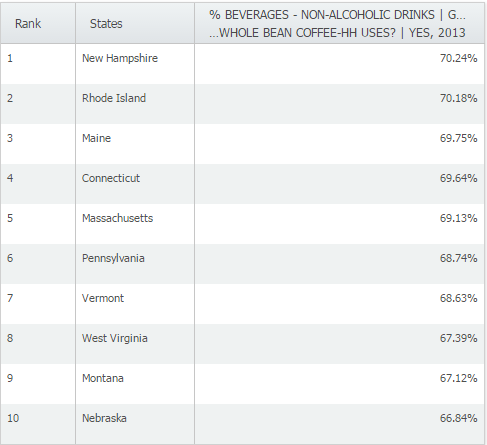 At 70.24%, New Hampshire narrowly edges out Rhode Island (70.18%) and Maine (69.75%) as the top states for household coffee drinking in the US. When we analyze by City, (by again adjusting the Analyze Data By drop down), and apply a population filter of greater than 75,000, the following cities make the top 10.
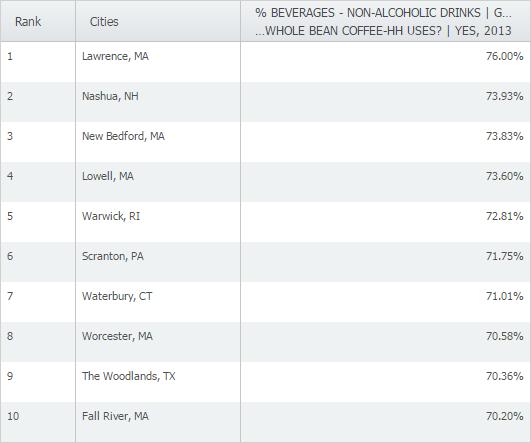 The residents of Lawrence, MA claim the top spot in the US (cities with population > 75k) for coffee drinkers at home. Lastly, we viewed the city of Lawrence by census tract.
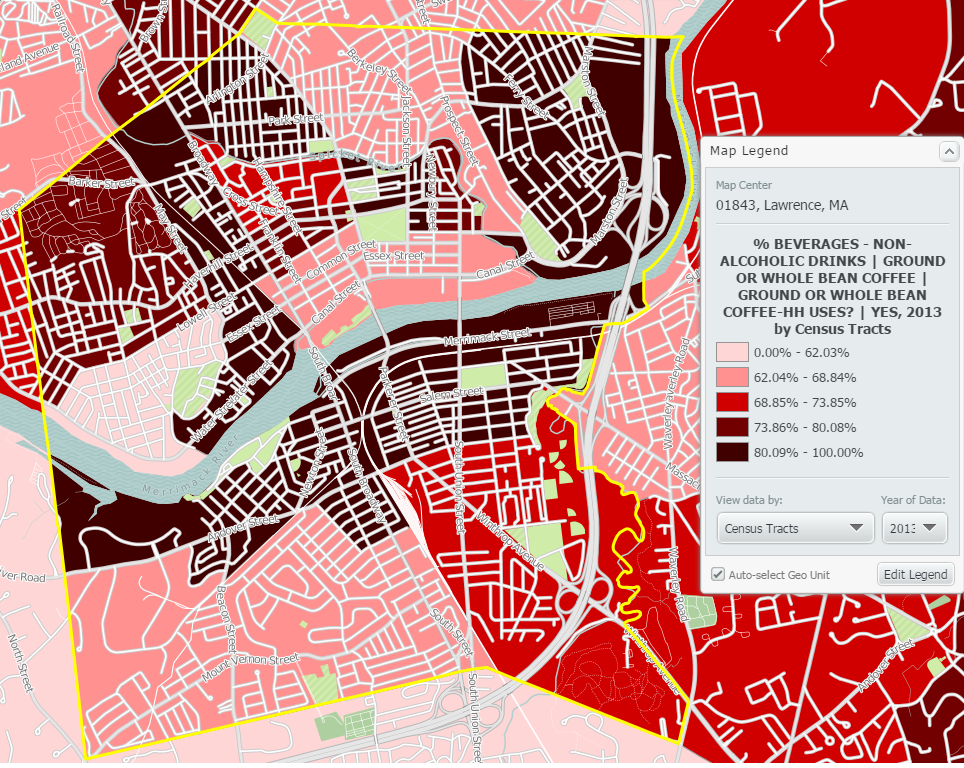 It looks like many of the residents in Lawrence, MA drink their coffee by the Merrimack River. What insights can be drawn from this? What other questions arise? Are there specific characteristics of these States, Cities, or Census Tracts that make their residents more inclined to drink coffee at home? Let us know your thoughts in the comments! Stay tuned for more SimplyMap tips and reports! Don’t forget to follow us on Twitter and like us on Facebook to stay up to date on all things SimplyMap (and score an entry to our iPad and Kindle Fire raffle while you are at it!).
More from SimplyAnalytics


Posted on May 26, 2016 by Admin
In this week’s report exploring SimplyMap data, we take a look at the variables available relative to internet search engines used. The source of this data will come from the SimmonsLOCAL...
Posted on Dec 12, 2011 by Admin
Men's Health magazine has published a ranked list to help readers find the cities where Americans are the saddest and where they are living with big smiles on their faces. As they note, "...
Posted on Nov 29, 2009 by Admin
The ALA 2010 Midwinter Meeting will be held on January 15-19, 2010 at the Boston Convention and Exhibition Center. (Note that this is not the Hynes Convention Center). Geographic Research...
Posted on May 19, 2016 by Admin
Drop by booth #215 at the SLA 2016 conference to chat with us and get the latest info on SimplyMap. We look forward to seeing our customers, friends, and all others interested in learning...
Posted on Jan 10, 2024 by Admin
We are delighted to announce our sponsorship of the Midwest Entrepreneurship Case Competition! At SimplyAnalytics, we understand the power of data-driven decision-making in entrepreneursh...
Posted on Jun 25, 2015 by Admin
In this week’s SimplyMap report, we review the different options available when searching for a business. The easiest and fastest method of mapping businesses or creating a business repor...
Posted on Feb 24, 2019 by Admin
Visit with the SimplyAnalytics team at this year's 14th annual Electronic Resources & Libraries Conference in Austin, TX! You can find us at Table 207, where we will be available to a...
Posted on Sep 21, 2009 by Admin
The North Carolina Library Association will hold its annual conference in Greenville, NC at the Greenville Convention Center from October 6-8, 2009. Geographic Research, Inc. will be exhi...
Posted on Nov 28, 2023 by Admin
Hello readers! We are happy to announce that SimplyAnalytics has successfully migrated to the Census 2020 boundaries on Sunday, November 19th. This blog will talk about what that is, what...
Posted on Feb 26, 2014 by Admin
The Statewide California Electronic Library Consortium is holding another packed week of workshops and networking during the SCELCapalooza event in March 2014. Geographic Research will b...