 Go up
Go up


Exploring SimplyMap Data: Internet Search Engines
Posted on May 26, 2016 by Admin
In this week’s report exploring SimplyMap data, we take a look at the variables available relative to internet search engines used. The source of this data will come from the SimmonsLOCAL data set which, as we’ve mentioned before, contains over 60,000 data variables. With that much data available, it’s safe to say that this series will be around for a very long time. Let’s get started!
Our general assumption here is that Google is the most used search engine in the United States. But does the data backup our assumption? Let’s find out.
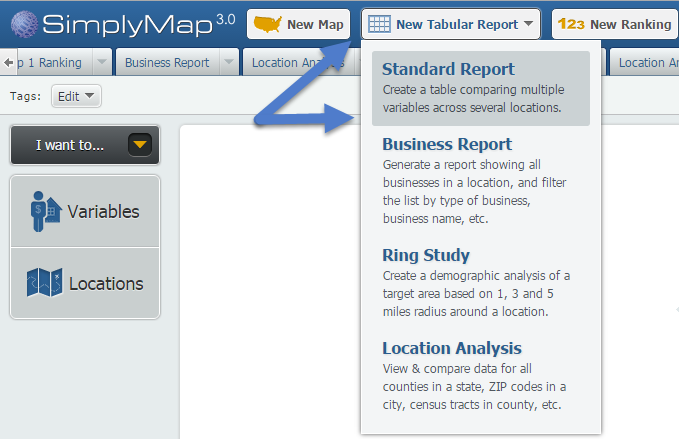
First, create a new Standard Report under the New Tabular Report button:
Next, open the Variables panel and navigate through the following path to find the variables of interest: SimmonsLOCAL » INTERNET » SEARCH ENGINES(COMPUTERS & OTHR DEVICES) » SEARCH ENGINES - HOW USED » SEARCH ENGINE I CURRENTLY USE MOST OFTEN.
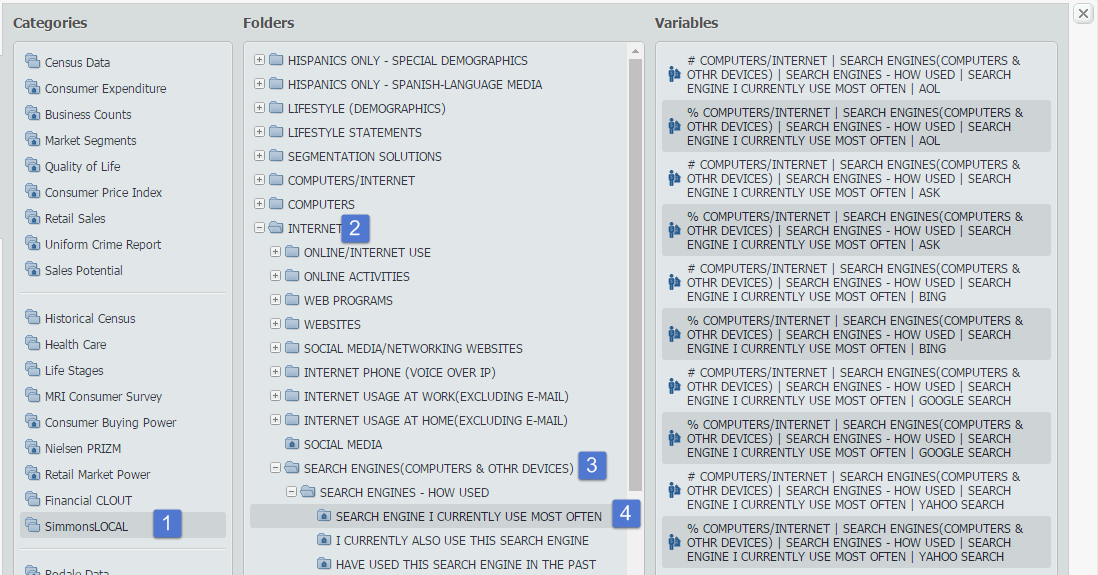
In total, there are four folders that contain search engine data, broken down by:
1. Search Engine I Currently Use Most Often
2. I Currently Also Use This Search Engine
3. Have Used This Search Engine in the Past
4. I Have Never Used this Search Engine
Each folder contains data on five search engines:
1. AOL
2. Ask
3. Bing
4. Google
5. Yahoo
As the path above indicates, we’ll be focusing on the first folder - Search Engine I Currently Use Most Often. Once you have selected the associated percent variables for the 5 search engines, close out your report to compile the data for the United States. Results below!
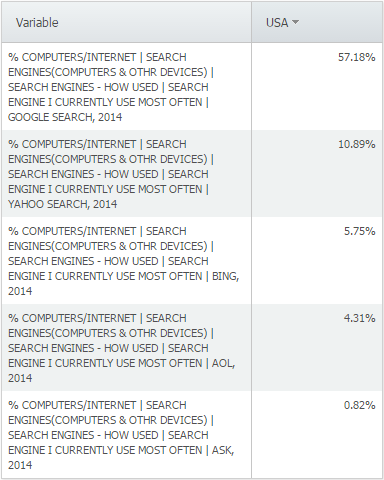
Our assumption was proven correct by the data, although the disparity between the search engines was surprising, with Google being the overwhelming favorite here in the United States.
Last week we posted a map challenging readers to guess what the map was portraying. The correct answer? Average Annual Snowfall (Total Inches)! If you guessed correctly, good job. If not, stay tuned for more!
More from SimplyAnalytics


Posted on Feb 19, 2016 by Admin
Drop by booth #857 at PLA 2016 to meet the SimplyMap team and learn more about the features and functions behind SimplyMap. Have a Ghirardelli Chocolate while we present SimplyMap and off...
Posted on Mar 02, 2009 by Admin
ACRL's 14th National Conference will be held at the Washington State Trade and Convention Center in downtown Seattle, March 12-15, 2009. Every other year, ACRL offers its premier profe...
Posted on Oct 02, 2015 by Admin
In this week’s SimplyMap tip, we wanted to do a quick write up reminding users about the Saved Tabs feature within SimplyMap. Did you know that SimplyMap will automatically save all of yo...
Posted on Mar 02, 2018 by Admin
In this week’s blog we’ll take a look at how to enter an address in SimplyAnalytics to find the Census Block Group or Census Tract. Let’s get started! Use Case: You want to analyze the ar...
Posted on Aug 13, 2015 by Admin
In this quick SimplyMap report, we use Census data to help us identify which city in the United States has the highest percentage of residents who reported walking to work as their mode o...
Posted on Jun 08, 2023 by Admin
We are excited to announce Mansi Nishit Trivedi as the winner of the 2023 BRASS Student Travel Award sponsored by SimplyAnalytics! Mansi, a Master of Information student at Dalhousie, has...
Posted on Dec 30, 2009 by Admin
Skokie Public Library, in Skokie, IL has published a useful overview of SimplyMap on the Mike's Space blog on SkokieNet. The article is filled with examples of research questions that can...
Posted on May 06, 2013 by Admin
We will be exhibiting at ALA 2013 at McCormick Place in Chicago, IL, June 28-July 1. The ALA Annual Conference programs, updates, conversations, and other events cover all of the key issu...
Posted on Jan 16, 2026 by Admin
We are excited to be exhibiting at the Public Library Association (PLA) 2026 Conference in Minneapolis this April 1-3!
Posted on Oct 26, 2016 by Admin
In this week’s SimplyMap report, we’ll take a look at the tags feature and demonstrate how it can be useful for you as you work in SimplyMap. SimplyMap users can have up to 20 tabs open i...